
Results of this run
Bisecting K-Means repeatedly halves Iris Flowers down to k=3. Split silhouette is 0.457, split Calinski-Harabasz is 241.3, split Davies-Bouldin is 0.832, split inertia is 140.08. Held-out species versus the splits: adjusted Rand 0.641. 0 noise rows out of 150 after the bisections. Bisected group 0 on Iris Flowers holds 51 rows (petal length (cm) 5.46 / sepal length (cm) 6.73). Bisected group 1 on Iris Flowers holds 49 rows (petal length (cm) 4.33 / sepal length (cm) 5.78). Bisected group 2 on Iris Flowers holds 50 rows (petal length (cm) 1.46 / sepal length (cm) 5.01). Bisection path: k 2 halves to 0.582 with 2 groups on Iris Flowers; k 3 halves to 0.457 with 3 groups on Iris Flowers; k 4 halves to 0.362 with 4 groups on Iris Flowers; k 5 halves to 0.289 with 5 groups on Iris Flowers; k 6 halves to 0.284 with 6 groups on Iris Flowers; k 7 halves to 0.297 with 7 groups on Iris Flowers; k 8 halves to 0.315 with 8 groups on Iris Flowers. Split scatter keeps 95.8%.
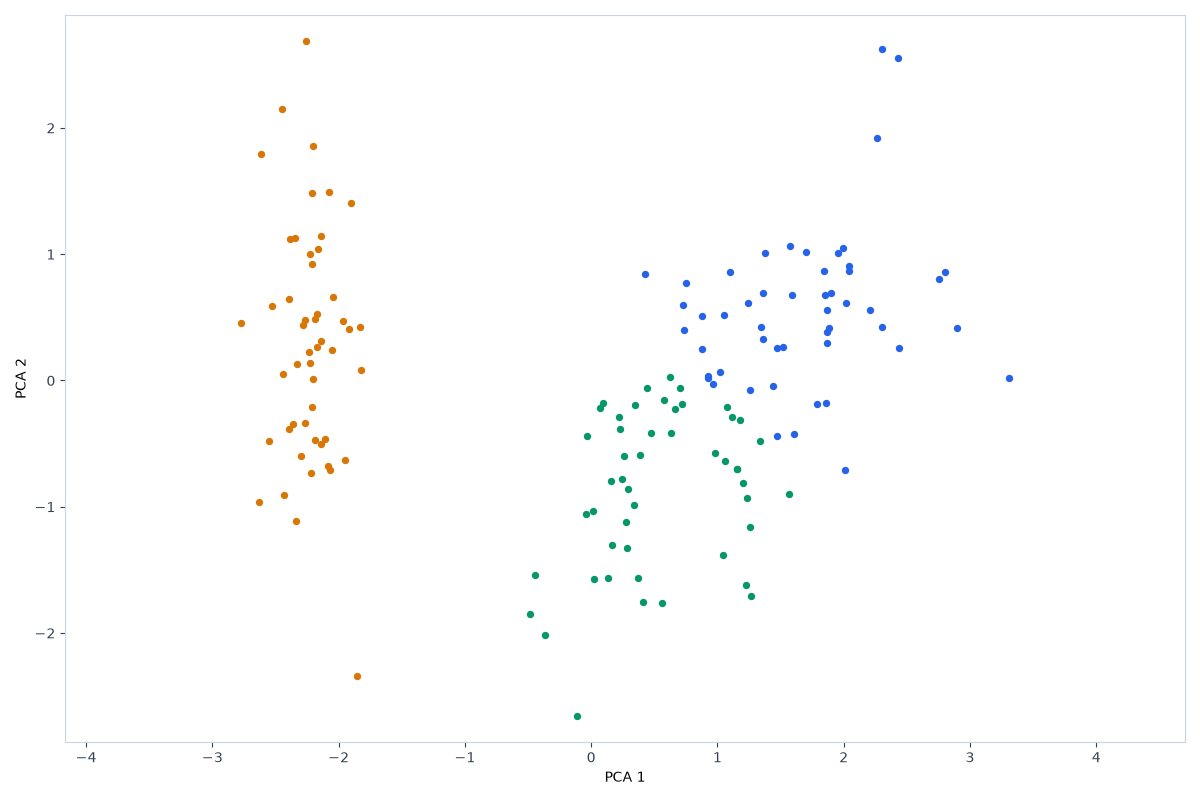
| k | Silhouette | Clusters |
|---|---|---|
| 2 | 0.582 | 2 |
| 3 | 0.457 | 3 |
| 4 | 0.362 | 4 |
| 5 | 0.289 | 5 |
| 6 | 0.284 | 6 |
| 7 | 0.297 | 7 |
| 8 | 0.315 | 8 |
from sklearn.cluster import BisectingKMeans
from sklearn.preprocessing import StandardScaler
Xs = StandardScaler().fit_transform(X)
labels = BisectingKMeans(n_clusters=3, random_state=42).fit_predict(Xs)
Who, how, and why
Method: StandardScaler, drop constant columns. Code version 3e4afc4b4352 (scripts/seo/build_explore_artifacts.py). scikit-learn 1.4.2. Seed 42. Dataset source: UCI Machine Learning Repository, Iris (Fisher, 1936). License: CC BY 4.0. The species column was held out of the fit and used only for the adjusted Rand score.
Results computed on 2026-11-02.
The results paragraph is filled from these numbers by a fixed template in the site code, so the scores can be checked against the same dataset in the tool.
Maintainer: nikolaou1982.
Contact: nick1982100@gmail.com.