
Results of this run
Mean Shift modes on Customer Segments use bandwidth 1.865 (quantile 0.3). Mode-seeking silhouette is 0.602, mode Calinski-Harabasz is 448.5, mode Davies-Bouldin is 0.515. The modes recover held-out segment at adjusted Rand 0.322. 0 noise rows out of 200 remain. Mode 0 on Customer Segments holds 147 rows (annual_income 43247.3 / avg_spend 966.8). Mode 1 on Customer Segments holds 53 rows (annual_income 77503.7 / avg_spend 2909.1). Mean Shift bandwidth check: bandwidth 1.865 returns 0.602 with 2 groups on Customer Segments. Mode plot variance kept: 90.5%.
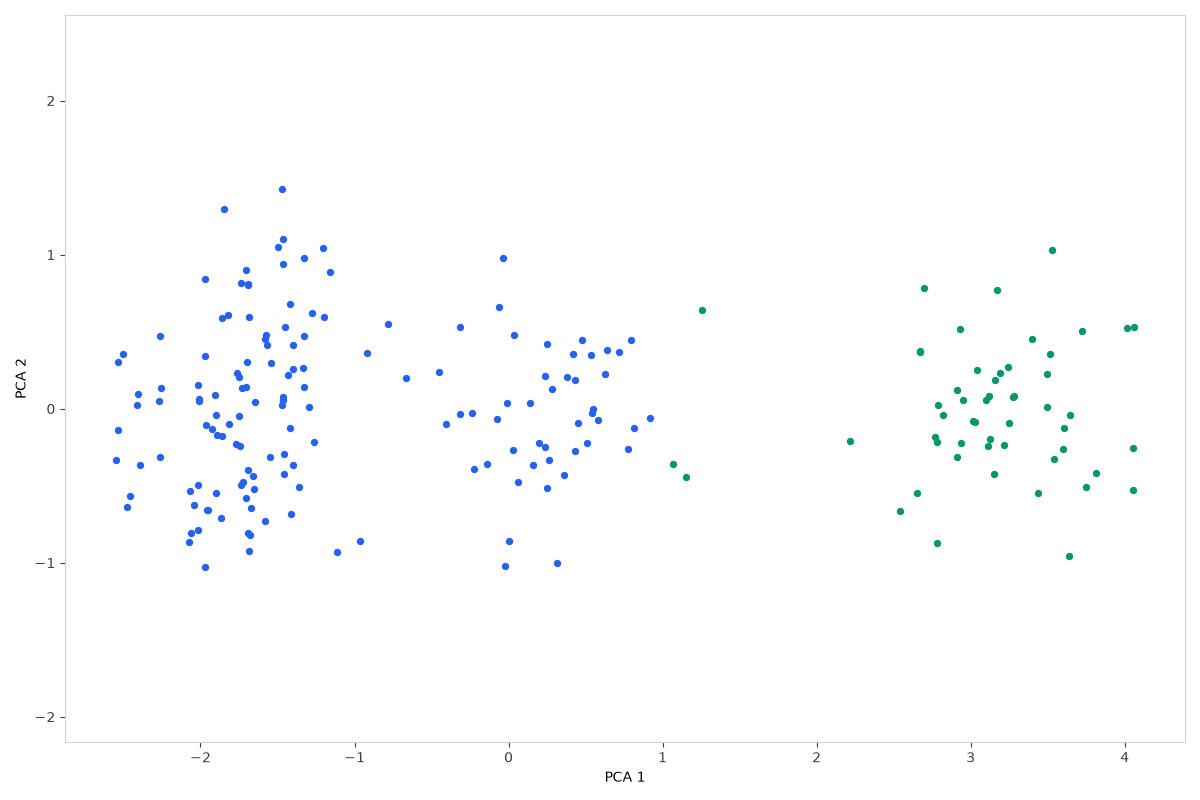
| bandwidth | Silhouette | Clusters |
|---|---|---|
| 1.865 | 0.602 | 2 |
from sklearn.cluster import MeanShift, estimate_bandwidth
from sklearn.preprocessing import StandardScaler
Xs = StandardScaler().fit_transform(X)
bandwidth = estimate_bandwidth(Xs, quantile=0.3, random_state=42)
labels = MeanShift(bandwidth=bandwidth, bin_seeding=True, cluster_all=True).fit_predict(Xs)
Who, how, and why
Method: StandardScaler, drop constant columns. Code version 3e4afc4b4352 (scripts/seo/build_explore_artifacts.py). scikit-learn 1.4.2. Seed 42. Dataset source: Synthetic customer records bundled with this site. License: Generated for demos; no external license. The segment column was held out of the fit and used only for the adjusted Rand score.
Results computed on 2026-11-02.
The results paragraph is filled from these numbers by a fixed template in the site code, so the scores can be checked against the same dataset in the tool.
Maintainer: nikolaou1982.
Contact: nick1982100@gmail.com.